
If you’re ready to expand your business by venturing into wholesaling, you’re making a wise move. Wholesale can significantly boost your revenue streams and provide balance to your business throughout the year when combined with direct-to-consumer (DTC) sales. To start reaching out to retailers and securing wholesale customers, you’ll need a well-crafted line sheet. A line sheet is essentially a concise document listing your product offerings and essential details. In this post, I’ll walk you through the key elements to include in your line sheet, with a focus on keeping it concise, ideally limited to a single page to avoid overwhelming your potential customers. Anything longer than one or two pages should be designed as a catalog, following a similar format.
Key Elements to Include in Your Line Sheet:
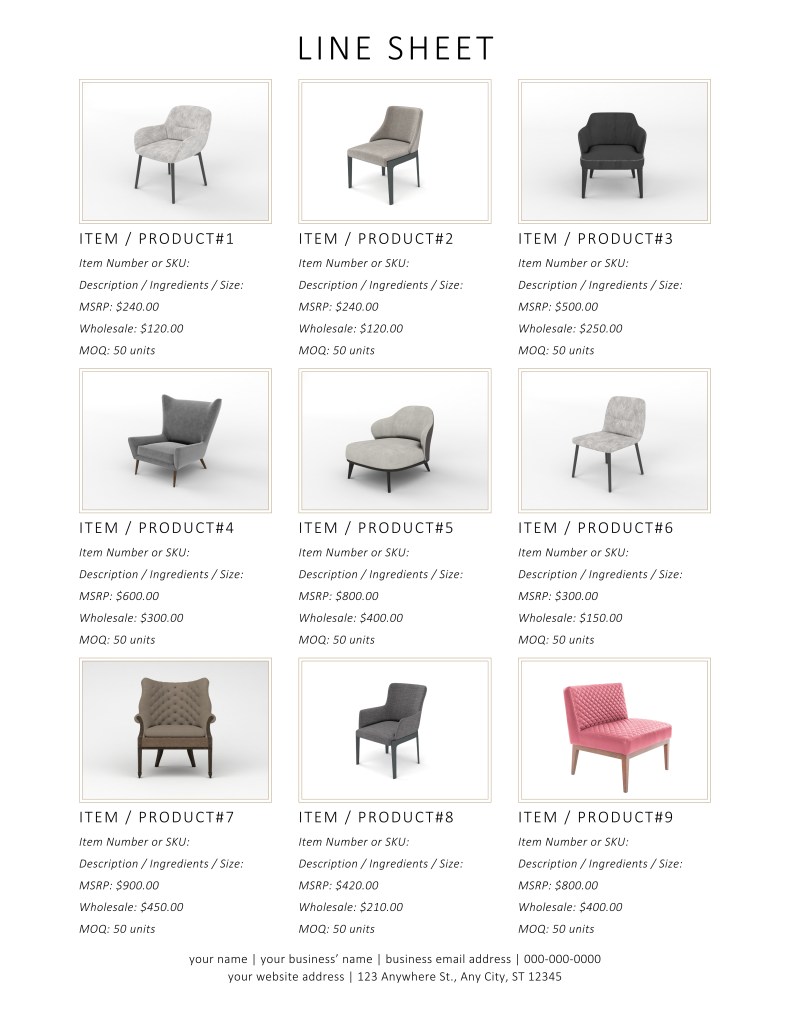
- Product Image: Provide a high-resolution image of the product on a white background to give your potential buyers a clear visual representation.
- Item Name: Clearly state the name of the product.
- Item Number or SKU: Assign a unique item number or SKU (Stock Keeping Unit) to simplify the ordering process and help with inventory management.
- Weight/Size: Specify the size or weight of each item for reference.
- Description: Offer a brief product description or, if applicable, list the ingredients in this section to give buyers an idea of what the product is.
- Prices: Include both the MSRP (Manufacturer’s Suggested Retail Price) and the WSP (Wholesale Price). The standard wholesale price typically amounts to 50% of the retail price, representing a 2x markup. However, depending on your product and industry, you might offer different pricing structures, such as a 40% wholesale price, but these often require larger MOQs.
- MOQ (Minimum Order Quantity): Clearly state the minimum order quantity for each product. Ensure that this quantity makes fulfilling the order worthwhile for your business. A good starting point is 25-50 units, but consider your customer base, industry norms, and product costs when determining the MOQ.
- Contact Information: Include your business’ contact information. This might seem obvious, but it’s crucial to ensure that buyers always have easy access to your details, without needing to search for them.
Here is a visual example of a line sheet for better clarity.
In addition to the line sheet, always provide an order form or a link where buyers can place their orders. Here’s what to include in your order form:
Order Form Details:
- Your business contact information.
- Order date.
- Buyer’s business name.
- Resale/Tax ID.
- Buyer’s name.
- Billing address.
- Shipping address.
- Phone number.
- Email address.
- Payment terms (e.g., minimum order amount, prepaid, Net 30, Net 60, or Net 90, depending on your agreement with the buyer).
- Shipping details, including lead time and preferred shipping company (e.g., USPS, UPS, FedEx), along with a FOB disclaimer specifying the city and state of shipment.
Here’s a link about FOB for a clearer understanding.
What does FOB mean in shipping?
Lastly, don’t forget to provide instructions for returns or exchanges if items arrive damaged or need to be returned. Clarity and transparency in your line sheet and order form will go a long way in building trust and successful wholesale partnerships.
Are you finding the tips helpful? Click the link to support the blog and keep helpful content coming your way.

 What's Trending Sage